Staged & Caused Accidents
Staged Accidents are “big business." Don’t become a victim.
Auto accidents happen every day on our nation’s roads, costing the property-casualty insurance industry billions of dollars in paid accident claims each year. Some target insurance providers exclusively. Others impact innocent motorists who become an unwitting participant in a fraud scheme.
Fraudulent Accidents are No Game
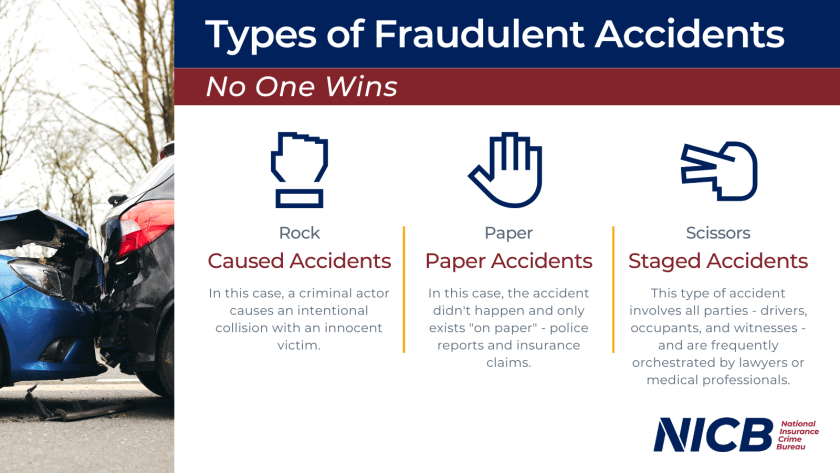
There are three common types of fraudulent accidents—each their own gamble. Think of them like a game of rock-paper-scissors with no real winner. Victims are forced to make repairs, insurance rates go up across the community, and the criminals who perpetrate these crimes face legal ramifications.
Rock—Caused Accidents
Think of a caused accident as the rock. In this case, a criminal actor causes an intentional collision with an innocent victim.
There are several schemes to cause accidents:
| Panic Stop | The driver positions themselves in front of a victim’s vehicle and waits for the victim to be distracted. Then the driver slams on the brakes causing the victim to crash into the rear of their vehicle. |
|---|---|
| Drive Down | The driver waves the victim to go ahead but will pull forward causing the victim to strike the vehicle. Later when asked, the driver will provide an excuse for waving their hand. |
| Swoop & Squat | This typically involves three vehicles, two driven by criminals and the third by an innocent victim. The driver of the “squat” vehicle pulls in front of the victim’s car. The driver of the “swoop” vehicle pulls in front of the squat vehicle, causing the driver of the squat vehicle to hit his brakes. The victim cannot react in time and rear-ends the squat vehicle. The swoop vehicle races off and is not seen again. The victim then typically is responsible for any vehicle damage and personal injury to passengers in the squat vehicle. |
| Freeway Swoop & Squat | This is the most dangerous of all the schemes as it’s usually performed on highways. Similar to the above, but four vehicles are typically involved, with three belonging to criminals. In this variation, the third criminal boxes in the victim so he cannot change lanes when the swoop vehicle cuts off the squat vehicle. Following the crash, the swoop and box-in cars speed off, again forcing the victim’s insurer to pay the claim. |
Paper—Paper Accidents
The most obvious example in this set of crimes is the paper accident. This is an accident that simply did not happen and only exists on “paper—” a police report and/or an insurance claim. Paper accidents often are reported as “private property” accidents, with no police involvement, or in “hit and run” accidents. Paper accidents are popular with organized groups, who report the accident to the police only to obtain supporting documentation for their insurance claim.
Scissors—Staged Accidents
A staged accident usually involves all parties: drivers, occupants and witnesses.
The vehicles are prepositioned to simulate a collision, seats and roles are assigned to participants and scripts provided to “passengers.” The “accident” may even be rehearsed. Sometimes in a staged accident, an accident never occurred. The criminals place vehicles with prior damage in a way that simulates an accident. The group may intentionally damage a vehicle(s) by striking a wall, tree or another vehicle intentionally, and then claim the damage occurred as a result of the accident.
In many cases, these “accidents” are organized by groups who partner with lawyers and involve medical professionals and clinics. The fraud extends into medical billing, defrauding insurance companies for even more money.
Questions & Answers
| What is a staged accident and how do they happen? | A staged accident involves two (or more) parties agreeing to fabricate an accident to defraud their insurance providers. |
|---|---|
| Is staging an accident a crime, and what are the penalties? | Staging an accident is a crime, as it is a form of fraud. Those who are found guilty can face hefty financial penalties and even jail time. |
| How do you avoid being drawn into a staged accident ring? | If an individual approaches offering financial incentives to participate in a staged accident, say no. If the initial scheme isn’t quickly uncovered, more likely than not, one scheme will snowball, embroiling you in the ring for good. |
| How does this affect my insurance premiums/claim? | Most accidents, especially ones that appear to be “at fault” will raise your insurance rates. The exact percentage is dependent on your insurance company. For more information, please reach out to your provider. Fraudulent accidents that you are not involved in cost the insurance industry and can result in higher premiums for us all. |
| How much does staged-accident fraud cost the industry overall? | Estimates cited range from about $20 billion per year according to the FBI to broader insurance fraud losses estimated at $308.6 billion per year by the Coalition Against Insurance Fraud. |
| Why are certain states (Florida, New York, California) hot spots for staged accidents and caused accidents — and why is this more common in no-fault states? | States with higher populations and more traffic see a higher volume of car accidents, and as a result, higher rates of staged accidents. This is even more common in no-fault states, because both drivers are required to report the accident to their insurance, allowing them both to collect reimbursement. |
| Why do occupants exaggerate injuries or exit the car holding their necks? | Occupants might exaggerate an injury by holding their necks to claim “whiplash,” or a neck sprain. While this is a real condition with unpleasant side effects, muscular injuries are difficult to detect, as most medical instrumentation cannot see a muscular injury. |
| Why does a "witness" appear out of nowhere to back the other driver's story? | In a staged or caused accident, a witness may “suddenly” appear because they part of the scheme too. We tend to believe when multiple people corroborate a story, so having a witness involved in the orchestrated scam makes the fraudulent accident appear more credible. |